
Fitted Wardrobes vs Freestanding: What Adds Value
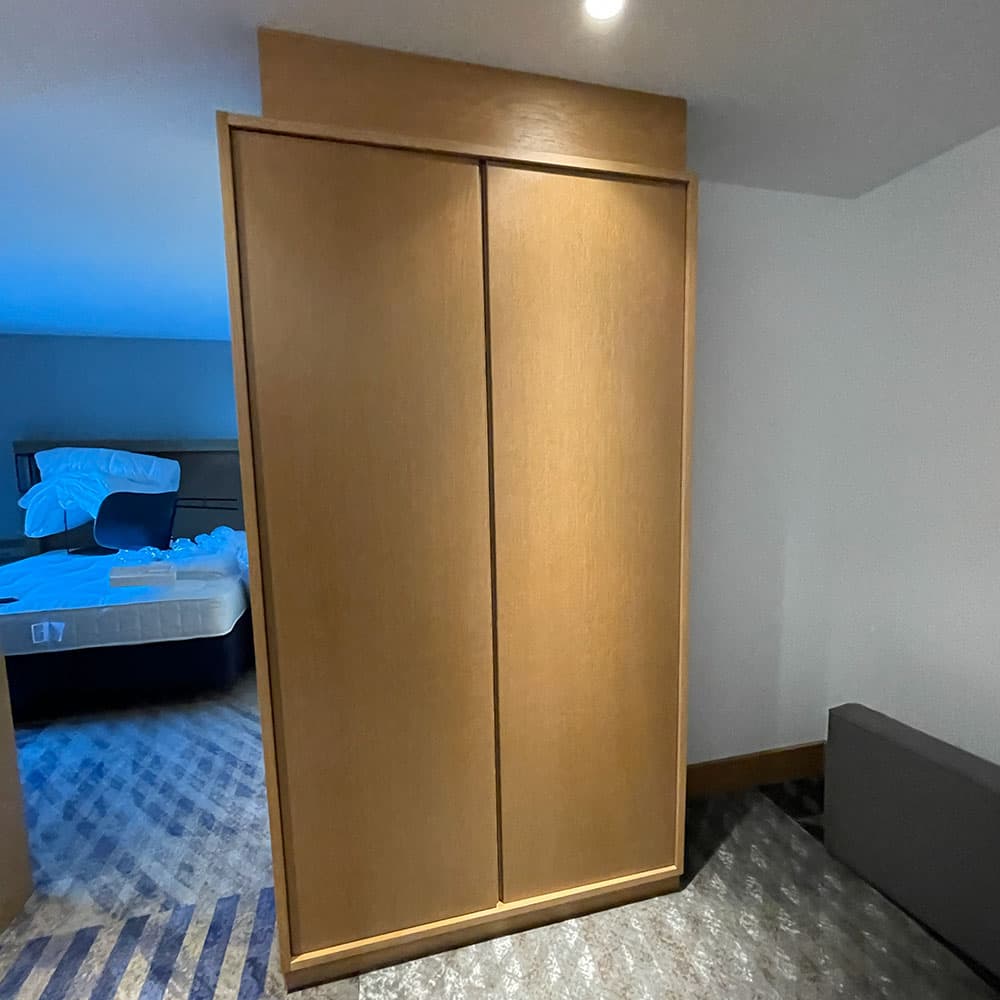
Fitted or freestanding is usually framed as a budget question. Fitted costs more, so the thinking goes, and freestanding is what you buy if you cannot stretch to it.
That is not wrong exactly, but it is the least useful way to approach the decision. Two more revealing questions: how long are you staying in the house, and what shape is the room? Answer those honestly and the choice usually makes itself, and in a fair number of Devon houses the answer is freestanding, which is not something you will often hear from a company that builds fitted wardrobes.
What “adds value” actually means
There are two different claims bundled into that phrase and they are worth separating.
The first is resale value: does a buyer pay more for a house with fitted wardrobes in it? The honest answer is that nobody can give you a reliable figure, and anyone quoting you a percentage is guessing. What is observable is softer and still real: fitted storage gets mentioned in estate agents’ particulars, it photographs well, and a bedroom that does not have a wardrobe standing in the middle of one wall looks bigger in a listing. On a period property in particular, joinery that looks built-in reads as a house that has been looked after.
The second is value to you while you live there, which is easier to be concrete about. A fitted run typically yields somewhere between a quarter and a third more usable storage than freestanding furniture in the same footprint, because it goes to the ceiling, into the corners, and up against the walls with nothing wasted behind or above. In a small bedroom that difference is the difference between storage that works and storage you fight with every morning.
If you are staying five years or more, the second claim is the one that matters and it is the stronger of the two.
When freestanding is genuinely the better buy
Three situations, and they are common enough to say plainly.
You are moving within a couple of years. Fitted joinery does not come with you. A good freestanding wardrobe does, and a very good one holds a surprising amount of its value. If the house is a stepping stone, do not build into it.
You are renting, or it is a rental property. Same logic with more paperwork.
The room is square, generous and has a flat ceiling. This is the one people do not expect. The whole case for fitted is that it solves awkwardness: slopes, alcoves, bays, chimney breasts. In a plain rectangular room with normal ceiling height, a well-chosen freestanding wardrobe gets you most of the capacity for considerably less, and you can move it when you repaint. Fitted is worth paying for where the room is difficult, and a square room is not difficult.
When fitted is the only thing that works
The mirror image of the above.
Eaves bedrooms. A sloping ceiling defeats freestanding furniture completely: a square box stops at the point where the slope cuts in, and everything beyond that is wasted. Fitted joinery follows the slope, with full-height hanging where the headroom allows, drawers or shelving where it narrows, and the lowest section given over to things you do not need to stand in front of.
Chimney breasts. You get two alcoves and they are almost never the same width as each other, which is why a matched pair of shop-bought units looks wrong in a way that is hard to put your finger on.
Bays, odd corners and doors in awkward places. Anywhere the usable wall is interrupted.
In a Devon housing stock that is heavy on cottages, converted lofts and Victorian terraces, that covers a great many bedrooms.
Cost, and the honest comparison
Comparing the two on headline price is misleading, because you are not buying the same thing. A useful comparison needs three adjustments.
Adjust for capacity. If the fitted run holds a third more, compare the cost per metre of hanging rail rather than the total.
Adjust for the rest of the room. Fitted work usually includes scribing to the walls, floor and ceiling, which means making good against surfaces that are not flat, level or square. Freestanding does not, and the gap it leaves is yours to live with.
Adjust for how long it lasts. Flat-pack has a life measured in years. Properly made fitted joinery in a house is a permanent fixture, and the hinges and runners are the only parts anyone ever has to think about again.
Once those three adjustments are made, fitted is usually still more expensive and the gap is smaller than the headline suggests.
If you do go fitted, spend the money on the inside
The commonest mistake is to spend the budget on door style and treat the interior as an afterthought. It is the wrong way round. The doors are what you see; the inside is what you use every day.
Before anything is designed, work out what is going in: how much long hanging against short, how many drawers, whether shoes live at the bottom or on a rack, what needs to be out of a child’s reach. Two people with identical rooms and identical budgets routinely end up with entirely different interiors, and the one who talked through their clothes gets the better wardrobe.
Our wardrobes and storage page sets out the range we build, from single runs to walk-in dressing rooms.
Where to start
If the room is awkward and you are staying, fitted is almost certainly right and the only real question is the layout. If the room is square and you are moving, buy a good freestanding wardrobe and spend the difference elsewhere.
If you are not sure which you are, send us photographs of the room and rough dimensions. We will tell you which we think makes sense, including when the answer is that you do not need us.